
Mapping Fancy Bear’s Gamefish Infrastructure
Unmasking Advanced Threat Operations Behind the Hash: 9b10685b774a783eabfecdb6119a8aa3 In the evolving world of cyber conflict, few adversaries operate with the consistency and sophistication of Fancy Bear (APT28).

Unmasking Advanced Threat Operations Behind the Hash: 9b10685b774a783eabfecdb6119a8aa3
In the evolving world of cyber conflict, few adversaries operate with the consistency and sophistication of Fancy Bear (APT28). Among their vast arsenal of tools, Gamefish a stealthy reconnaissance and remote access implant, has featured prominently in operations targeting defense contractors, foreign ministries, and even hospitality networks frequented by diplomats.
At Alpha Cyber, we specialize in dissecting and mapping the adversarial infrastructure behind state-sponsored malware. Today, we turn the spotlight on the infrastructure supporting a known Gamefish campaign, linked to the document Hotel_Reservation_Form.doc, hash 9b10685b774a783eabfecdb6119a8aa3 a file used in spear-phishing attacks to deploy the malware.
Why Infrastructure Mapping Matters
Threat actors don’t operate in a vacuum. Every campaign, phishing lure, or implant like Gamefish relies on a robust back-end infrastructure to:
- Deliver payloads
- Control compromised endpoints
- Exfiltrate sensitive data
- Evade detection and takedowns
By reverse-engineering the infrastructure behind a single malicious artifact, we expose the broader campaign footprint, often revealing relationships between domains, IP addresses, malware families, and reused command-and-control nodes.
From Document to Deployment: A Chain Revealed
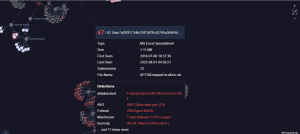
Starting with the document hash 9b10685b774a783eabfecdb6119a8aa3, our infrastructure analysts were able to trace the malware’s lifecycle across several phases:
Initial Access
Filename: Hotel_Reservation_Form.doc
Technique: Weaponized Word document with embedded macro
Behavior: Executes PowerShell stager upon user enablement of content
Payload Delivery
The downloader connects to remote resource hosting the Gamefish loader
Observed behavior: Beaconing to dynamically generated subdomains over HTTP
Command-and-Control
Dynamic DNS domains registered days before the campaign began
C2 Infrastructure: Hosted in Eastern Europe and mirrored across VPS providers to avoid takedowns
Lateral Movement & Recon
Upon successful implant deployment, internal network scanning and credential harvesting via native tools (e.g., netstat, tasklist, ipconfig)
Visualizing the Threat: Infrastructure Mapping Results
Our infrastructure mapping process produced a comprehensive graph of the Gamefish operation, beginning with a single file hash and unraveling an entire adversarial ecosystem. Key observations include:
Pivot points between spear-phishing campaigns using similar delivery infrastructure
Shared C2 nodes linked to other Fancy Bear malware strains (e.g., Seduploader, Zebrocy)
Infrastructure reuse across multiple campaigns, suggesting a persistent operational framework behind the malware
These insights enabled us to proactively identify and block associated artifacts before they could impact client environments.
Why This Matters to You
Whether you’re defending a multinational enterprise or a critical infrastructure provider, understanding adversarial infrastructure is the difference between reacting to a breach and preventing one. Starting from a single artifact, we provide:
- Full infrastructure mapping and campaign attribution
- Timeline reconstruction of attacker movements
- Identification of infrastructure reuse across multiple threat actors
- Actionable intelligence for network and endpoint protection
The Bottom Line: Actionable Intelligence from a Single Hash
From one malicious document (MD5: 9b10685b774a783eabfecdb6119a8aa3), we built a complete picture of Fancy Bear’s operational framework in a real-world campaign. This level of insight empowers defenders to:
- Block communication with malicious C2 domains
- Harden systems against known TTPs
- Monitor for reused infrastructure in future campaigns
Ready to See the Bigger Picture?
If you’re relying only on signature-based defenses or isolated malware analysis, you’re only seeing part of the threat. Let us show you what the adversary doesn’t want you to see the map behind the malware.
Contact us today to gain visibility into adversarial infrastructure targeting your sector.