
Silencing the Panic Button: Inside the Linux SysRq Rootkit That Evades Forensics
Imagine your server starts behaving erratically. You suspect a breach, but your monitoring tools are silent.
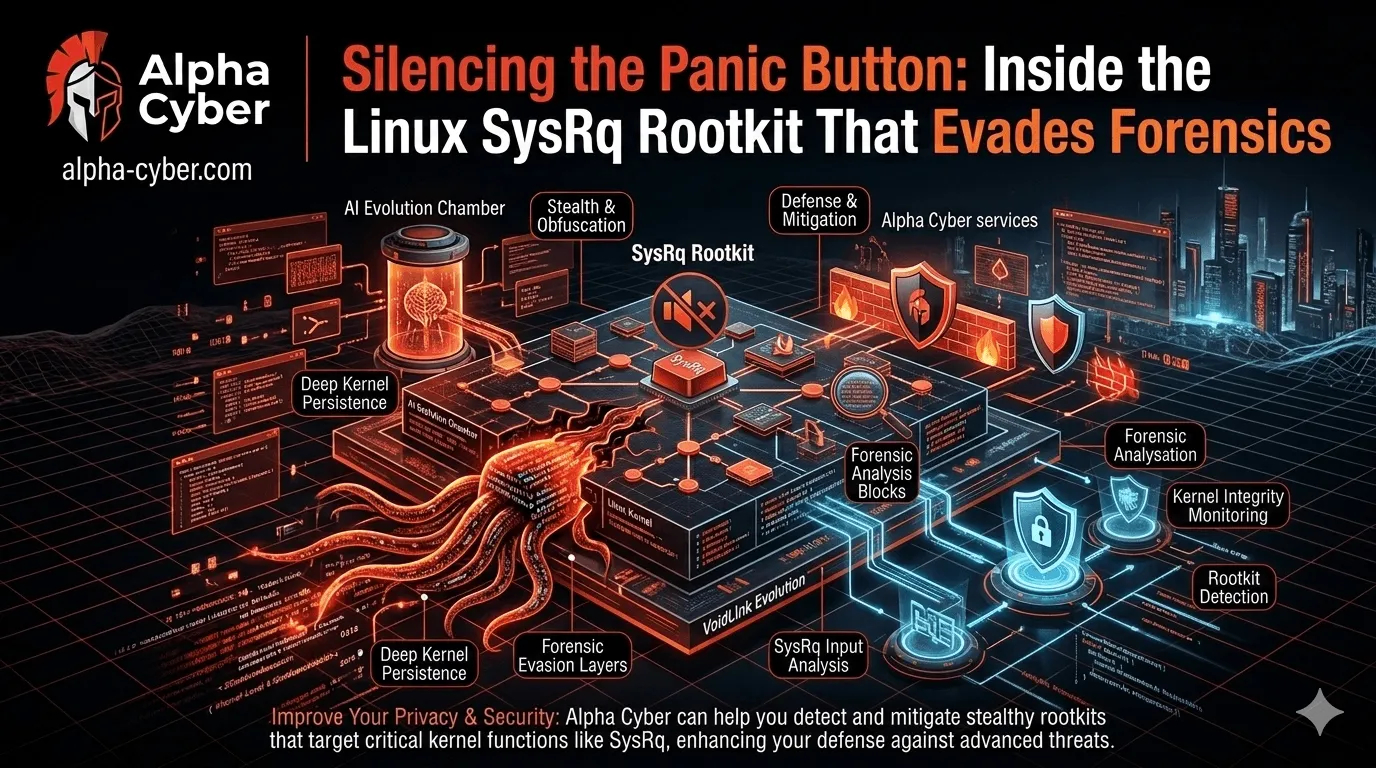
The Linux “Panic” Button is Broken: How Modern Rootkits Silence Your Best Forensics
Imagine your server starts behaving erratically. You suspect a breach, but your monitoring tools are silent. In a last-ditch effort to preserve evidence, you trigger a Kernel Panic or use the Magic SysRq key the “emergency brake” designed to dump memory and reboot the system cleanly for forensic analysis.
Nothing happens.
Welcome to the new era of Linux kernel exploitation. A sophisticated breed of rootkits is no longer just hiding files; they are weaponizing the Magic SysRq handler to ensure that when your system fails, it takes its secrets to the grave.
The Weaponization of the Heart of Linux
The Magic SysRq key is a low-level interface in the Linux kernel that allows users to perform diagnostic tasks regardless of the system’s state. It is the ultimate fail-safe. However, recent research into frameworks like Singularity has revealed a chilling methodology: SysRq Hooking.
By intercepting these low-level commands, a rootkit can:
Ignore the “Reboot” command: Preventing a clean restart that might clear malicious memory-resident code.
Disable “Sync”: Ensuring that cached data including logs showing the attacker’s footprint is never written to the disk.
Mask Memory Dumps: If a forensic investigator tries to dump the RAM, the rootkit can redirect the output or provide “sanitized” data that hides the malware’s presence.
Why Traditional Forensics Fails
Standard EDR (Endpoint Detection and Response) tools live in the “User Space” or the higher levels of the kernel. These rootkits operate in the “dark matter” of the OS.
By the time you realize something is wrong, the rootkit has already altered the kernel’s perception of reality. If the emergency brake (SysRq) is compromised, your incident response team is essentially flying blind. You aren’t just dealing with a virus; you’re dealing with a hijacked operating system that is actively lying to you.
How to Detect the Undetectable
Because these threats exist below the level of standard logs, detection requires a shift in strategy. Our team specializes in Deep Kernel Memory Analysis and Out-of-Band Monitoring to spot the subtle “shimmers” these rootkits leave behind.
Critical Indicators of a Hooked Kernel:
SysRq Latency: Unexplained delays when executing low-level diagnostic commands.
Mismatched Symbol Tables: Discrepancies between the
/proc/kallsymsand the actual memory addresses of kernel functions.Silent Panics: A system that freezes but fails to generate a
vmcorefile or a kernel oops message.
Can Your Infrastructure Survive a “Silent Panic”?
If you are running high-value Linux workloads in the cloud or on-prem, a standard antivirus isn’t enough. You need a partner who understands the intricacies of eBPF, LKM, and kernel-level persistence.
Don’t wait for the emergency brake to fail.